What are value studies?
A value study is a simplified painting or drawing that reduces a reference image to a few flat tones — light, mid-tone, and shadow — so you can focus on tonal relationships instead of colour or detail. By practicing value studies you’ll not only get better at simplifying any subject into light, mid-tone, and shadow, but you’ll also build a visual library of forms, atmospheres, and lighting conditions. Value Studies Coach is a free tool for art students, illustrators, or anyone who wants to train their eye for light and shadow.
What’s new — Re-roll an image
- A “New image” button in the study view swaps the current reference for a different one from the same set, without moving on to the next image or using up a slot in your session. The timer restarts for the new image.
Procedure
Grab paint and a panel — or any drawing materials. Pick a category, your time per painting, and how many paintings you want in the session.
When you start, a break down of the image will appear on the right along with a timer. You can hide the breakdown to make it more challenging.
Match the major tonal shapes of the reference within the time limit. The image will advance once the timer runs out.
Prefer to work without pressure? Pick “Untimed” instead of a time limit. A stopwatch counts up so you can still see how long a study takes, but nothing advances until you press Next.
At the end of a session you’ll see a gallery of everything you studied. Click any image there to practise it again untimed — useful for the one that got away — then head back to the gallery when you’re done.
Adjust the number of tones (3, 5, or 7) to control how much the reference is simplified. Switch between colour and greyscale modes — greyscale forces you to think purely in values.
For your own photos or favourite paintings, choose the “Use Your Own Images” category.
Examples
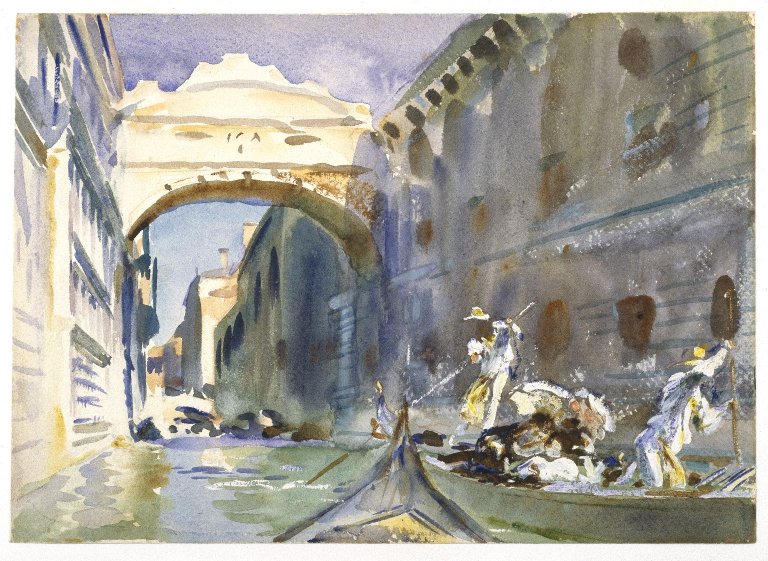
John Singer Sargent is one of the great masters of value. His Venice watercolours collapse a complex city of stone, water, and shadow into a handful of decisive tonal shapes — that’s the perception you’re training.

Tips
- Squint at the reference to collapse mid-tones and reveal the big shapes.
- Block in the largest tonal masses first, then refine details.
- Aim for a clear separation between light and shadow before adjusting any individual value.
- You’ll improve each session, but it takes time and practice.
- Learn from your mistakes. If you do this you’ll improve much faster.
- Make these exercises a daily habit and you’ll surely improve a lot!
- Find your best study from the previous session and aim to beat it this session.
- Challenge yourself with a shorter time limit every couple of weeks.
- Try to finish each study within the time limit.
- If you can’t finish on time, give yourself a longer limit until you can.
- Try different materials — gouache, oil, charcoal, ink wash — to see what each teaches you about value.
- Don’t forget to have fun.
Frequently asked questions
How do I do a value study?
Pick a reference image and squint at it to collapse the mid-tones, then map what you see into a small number of flat tones — usually three to five. Block in the largest light and shadow shapes first, keep each shape a single value, and only refine once the big tonal pattern reads clearly. A timer helps you commit to the big shapes instead of fussing over detail.
Why are value studies important?
Value does most of the work in a believable image — it reads the form, the light, and the depth before colour ever registers. Training your eye to see and simplify values makes your paintings and drawings more convincing, and the habit transfers to every subject you tackle.
How many values should a value study have?
Start with three values — light, mid-tone, and shadow — to force clear, simple decisions. As you improve, move up to five or seven tones for more nuance. Value Studies Coach lets you switch between 3, 5, and 7 tones so you can control exactly how much the reference is simplified.
What is the difference between value and colour?
Value is how light or dark something is, regardless of its hue; colour adds hue and saturation on top. Two very different colours can share the same value. Practising in greyscale mode strips out hue entirely so you can judge value on its own — the foundation everything else sits on.
Do I need to sign up or give my Pinterest details?
No. There’s no account to create and we never ask for or store your Pinterest password. When you choose the Pinterest option you’re sent to Pinterest’s own login to authorize access, and we simply connect to your account to pull in the images from your public boards for your session.
Is Value Studies Coach free?
Yes. Value Studies Coach is completely free. Choose a category, set a timer, and practise timed, posterized value studies in your browser — you can also use your own images or connect a public Pinterest board.